- New


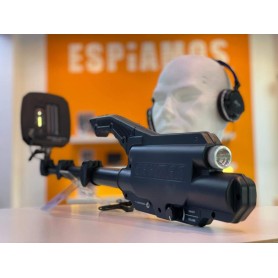
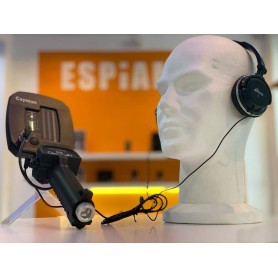
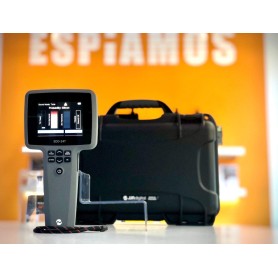
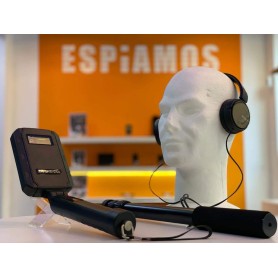
The NLJD 3HECA-02 4W is the high-power version of the nonlinear junction detector with display and third harmonic detection: same compact design, now with a 4000 mW EIRP transmitter that doubles the detection range to 200 mm over inactive SIM cards . It retains the integrated display , second and third harmonic detection , and 3.5 mm headphone output , with adjustable power for inspecting dense structures and large surfaces with greater ease.
 3-Year Warranty: Certified quality on all products
 100% Secure Payment PayPal / Visa / Mastercard
 Free 24h Delivery: Express shipping with DHL, FedEx or UPS
 14-Day Return: No-commitment shopping
The NLJD 3HECA-02 4W is the high-power version of the 3HECA-02 nonlinear junction detector: same compact design, same integrated display, and same second and third harmonic detection, but with a transmitter of up to 4000 mW EIRP , eight times the power of the standard model. This leap translates into a greater detection range, up to 200 mm on a SIM card, and more scope for inspecting furniture, partitions, and volumes where hidden electronics are located at greater depths.
It's designed for TSCM technicians, detectives, and security departments already familiar with sweep methodology who need an NLJD that performs well in large rooms, dense structures, or inspections where every centimeter of range counts. Below, we detail the differences compared to the 3HECA-02, its verified specifications, and when the 4W version is the best choice.
The difference between the two models lies in the transmitter. The standard 3HECA-02 emits with an EIRP of less than 500 mW; the 4W version reaches 4000 mW EIRP, while maintaining pulse mode and automatic or manual adjustment in four 3 dB steps. Everything else—housing, LCD screen, second and third harmonic receivers, headphone output, batteries, and telescopic stand—is identical.
In practice, that additional power provides:
If your usual work involves offices, vehicles, and medium-sized meeting rooms, the standard 3HECA-02 will meet your needs. The 4W version addresses the next level of requirements.
The device emits radio frequency pulses toward the surface being inspected. When the signal reaches a nonlinear junction, such as that of a semiconductor, it generates harmonics that the detector receives and measures. Electronic components produce a dominant second harmonic; oxidized or loose metal junctions produce a proportionally stronger third harmonic. By comparing both, the operator can classify the response before opening or disassembling anything.
Therefore, a nonlinear junction detector locates electronics that an RF detector cannot see: devices that are switched off, at rest, or recording locally without transmitting. In any case, the reading is an indication that requires physical confirmation by a qualified technician.
Extra power makes sense when the environment demands it. Typical examples are:
In confined spaces or with a lot of legitimate electronics, it is advisable to work at low power levels and only increase them at points of interest; manual adjustment is precisely for that purpose.
| Parameter | NLJD 3HECA-02 4W |
|---|---|
| Transmitter | ISM band 2400 MHz, pulsed mode |
| Maximum transmitted power | 4000 mW EIRP |
| Power adjustment | Automatic and manual (4 steps of 3 dB) |
| Receptors | Second and third harmonic |
| Receptor sensitivity | -135 dBm |
| SIM card detection | Up to 200 mm |
| Interface | LCD screen |
| Headphones | 3.5 mm connector |
| Feeding | 2 rechargeable Li-ion or LiFePO4 type 14500 batteries (AA size), internal charging |
| Autonomy | Up to 4 hours of continuous operation |
| Main unit dimensions | 150 x 150 x 80 mm (maximum) |
| Telescopic support | From 0.27m to 0.9m, GoPro mount |
| Weight | 350 g the main unit with batteries (maximum) + 120 g the telescopic support |
A 4W NLJD is a professional inspection tool. Full-power transmission in the 2.4 GHz band can temporarily interfere with Wi-Fi networks and nearby devices, so sweeps should be planned and power settings used judiciously. Use of the equipment must always comply with applicable regulations in the country and the legitimate scope of the inspection.
Furthermore, the harmonic response indicates the presence of a nonlinear junction, but it does not identify the device. Precise localization, physical verification, and documentation of the finding are part of the methodology taught in our electronic countermeasures training , and these are what transform a reading into a defensible conclusion.
The only difference is in the transmitter power: the NLJD 3HECA-02 4W achieves 4000 mW EIRP compared to less than 500 mW for the standard model, doubling the reference distance over a SIM card (200 mm vs. 100 mm). The display, second and third harmonic receivers, headphones, batteries, dimensions, and stand are identical.
Yes. The unit allows automatic and manual adjustment in four 3 dB steps, so you can work at low levels in electronically busy environments and reserve maximum power for critical points.
Yes. Detection is based on the harmonic response of semiconductors, not on the device emitting a signal. Therefore, it locates recorders without transmission, SIM cards, and circuit boards even when they are turned off or without a battery. The discovery then requires physical verification.
To reduce false positives. Oxidized metal junctions, screws, or loose contacts generate a relatively strong third harmonic, while semiconductors excel in the second. Comparing both readings on the screen allows you to rule out responses that are not related to electronics.
The NLJD 3HECA-02 4W retains everything that makes the 3HECA-02 useful—compact form factor, display, dual harmonics, and discrete monitoring—and adds the power needed for demanding inspections. If your sweeps include dense structures or large surfaces, this is the right version; otherwise, the standard model remains the well-balanced choice.
You can compare both models and the rest of the electronic scanning equipment in our catalog, or consult our technical team to assess which configuration suits your type of inspection.
The NLJD 3HECA-02 4W is the high-power version of the nonlinear junction detector with display and third harmonic detection: same compact design, now with a 4000 mW EIRP transmitter that doubles the detection range to 200 mm over inactive SIM cards . It retains the integrated display , second and third harmonic detection , and 3.5 mm headphone output , with adjustable power for inspecting dense structures and large surfaces with greater ease.